 AI Mac Cleaner
How to Uninstall OneDrive Completely on a Mac
Dragging OneDrive to the Trash leaves preferences, caches and sync-state files behind — and your synced OneDrive folder is a separate concern entirely. Here's how to remove both properly.

If you want to uninstall OneDrive completely on a Mac, there are two separate things to deal with, not one. Dragging the OneDrive app to the Trash removes the program itself, but it leaves behind preference files, a sync-state cache and support folders under ~/Library — the usual leftover pattern for almost any Mac app. On top of that, OneDrive has its own synced folder (or folders, if you use more than one account) living under ~/Library/CloudStorage, which is a completely separate concern from app leftovers and needs its own decision before you touch it.
Why dragging the app to the Trash isn't enough
On macOS, the icon in /Applications is the program, but very little of what an app does while running stays confined to that bundle. From the moment you sign in and OneDrive starts syncing, it writes settings, a sync-state database, and cached thumbnails into several folders under your user Library that have nothing to do with the app bundle you just deleted. Removing the bundle doesn't touch any of them, and for a continuously-running sync client like OneDrive, that typically means a meaningful amount of cache and database data left behind, not just a small settings file.
Where OneDrive's app leftovers actually live
These are the general locations where macOS apps — OneDrive included — keep data outside their own bundle. The folders themselves are standard; exactly what OneDrive puts inside each one is internal to its own code:
~/Library/Preferences— a.plistsettings file: account connections, sync preferences, window state.~/Library/Caches— temporary data, including cached thumbnails and previews. Always safe to remove.~/Library/Application Support— the main data folder, and typically the largest for a sync client: local sync-state databases, Files On-Demand status, and related support files.~/Library/Logs— diagnostic logs from the sync process.
A full app uninstall means clearing the OneDrive-specific folder inside each of those four locations, on top of removing the app itself. We cover this same four-folder pattern in more depth for Zoom and for Dropbox, since it's near-identical for any app that runs continuously in the background the way OneDrive does.
The separate question: your synced OneDrive folder (or folders)
This is the part that's easy to get wrong. Uninstalling the OneDrive app should never delete the actual files inside your synced OneDrive folder — those are your files, synced to Microsoft's servers, and macOS (and OneDrive) deliberately keep that folder separate from the app's own Library leftovers so that removing the app doesn't wipe out your synced data. That folder lives under ~/Library/CloudStorage/OneDrive-<account>, the same general location Google Drive, Dropbox and Box use for their own desktop sync clients — and if you sync both a personal and a work/school account, each one gets its own separate folder there, which needs its own separate decision.
That distinction matters because it changes what "removing" the folder actually does: content kept there isn't a cache you can clear and forget — moving it to the Trash tells OneDrive to delete it from your Microsoft account too, not just free local space. That's materially different from clearing an app's cache, and worth treating with more care specifically because it touches your account's data, not just this Mac.
How AI Mac Cleaner handles each piece
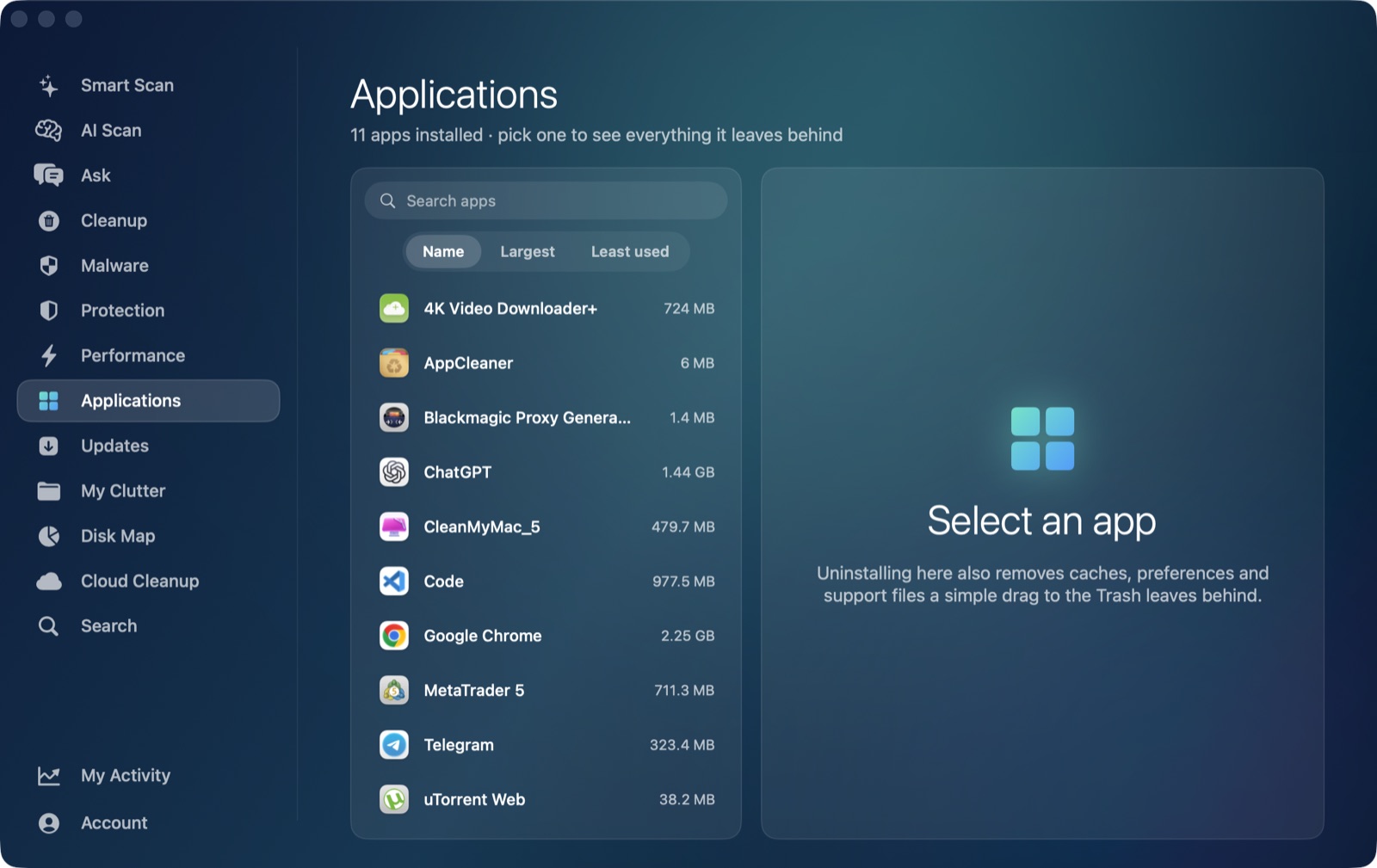
AI Mac Cleaner's Applications module is the app-leftover tool here: point it at OneDrive and it works as an uninstaller that also finds leftovers in ~/Library, matching on the app's own bundle identifier rather than guessing from its display name, so it won't accidentally catch some unrelated app that happens to share part of the name. You get a list of what it found — preferences, caches, support data, logs — before anything moves, and the module never lists Apple's own apps, itself, or Claude as something you could remove.
For the separate synced-folder question, that's the Cloud Cleanup module's job, not the Applications module's: it treats each ~/Library/CloudStorage/OneDrive-* folder the same way it treats Google Drive, Dropbox and Box, showing the local footprint of what's synced there and the largest downloaded files, per account if you have more than one. Because OneDrive isn't iCloud, Cloud Cleanup doesn't have an "evict without deleting" option for it the way it does for iCloud Drive — your choices are Show in Finder or Move to Trash, with the app warning upfront that moving OneDrive-synced content to the Trash deletes it from your Microsoft account as well, not just locally. Folders that look like code projects (containing .git, package.json, .xcodeproj, node_modules and similar markers) are skipped by the scanner entirely, so it won't surface or touch a project you keep synced there.
Whichever module you're using, nothing goes straight to permanent deletion: everything routes through the same Trash-only remover, with a hard-coded list of protected paths it refuses to touch regardless of what a scan finds — recoverable from the Trash until you empty it yourself, on purpose.
The order that makes sense
If you're removing OneDrive for good: decide what happens to your synced files first for every account you have syncing (keep a local copy outside the OneDrive folder if you want to keep anything, since moving the synced folder to the Trash deletes it from your account), then uninstall the app and clear its ~/Library leftovers with the Applications module. Doing it in the other order risks losing track of which files were ever actually backed up anywhere else.
AI Mac Cleaner has a 7-day free trial with every feature unlocked and no card required, plans from $6.99/mo after.
Frequently asked questions
Does deleting the OneDrive app from Applications remove everything?
No. It removes the app bundle, but preferences, caches, the Application Support sync database and log files stay behind in ~/Library, and your actual synced OneDrive folder (or folders, for multiple accounts) is untouched either way.
Will uninstalling OneDrive delete my files in the OneDrive folder?
No — removing the app itself never touches your synced folder. That folder is a separate thing from the app's own Library leftovers, specifically so uninstalling the app can't accidentally wipe your synced files.
Where does OneDrive's synced folder actually live on a Mac?
Under ~/Library/CloudStorage/OneDrive-<account> — one folder per account if you sync both a personal and a work/school OneDrive. This is the same general location other cloud providers like Google Drive and Dropbox use for their own desktop clients.
Does moving my OneDrive folder to the Trash delete it from my Microsoft account?
Yes, for the OneDrive-synced folder specifically — unlike clearing a cache, this deletes the content from your account, not just from this Mac. AI Mac Cleaner's Cloud Cleanup module warns about this before you confirm, the same way it does for Dropbox and Google Drive.
Does AI Mac Cleaner have a dedicated OneDrive uninstaller?
Not a OneDrive-specific one — its Applications module is a general uninstaller that finds any app's leftovers in ~/Library by matching the app's own bundle identifier, which covers OneDrive the same way it covers Dropbox, Zoom, Slack or any other installed app.
