AI Mac Cleaner
OneDrive Taking Up Space on Your Mac? Here's Why
OneDrive's "Files On-Demand" setting decides whether synced files sit as cloud placeholders or full local copies — plus a separate cache folder that grows regardless. Here's where the space actually goes.

OneDrive is Microsoft's answer to "keep my files in the cloud," but it's common to see tens of gigabytes under OneDrive's folder in About This Mac anyway. The reason is almost always one specific setting — Files On-Demand — plus a cache folder OneDrive keeps regardless of how that setting's configured.
The setting that decides almost everything: Files On-Demand
OneDrive for Mac has a feature called Files On-Demand, and whether it's doing its job for a given file or folder is the single biggest factor in how much local disk space OneDrive actually uses:
- Online-only files show up in Finder and in OneDrive's own folder listing, but their actual content stays on Microsoft's servers until you open the file — at which point it downloads and becomes "locally available."
- "Always keep on this device" — a per-file or per-folder command in Finder's right-click OneDrive submenu — forces a permanent local copy, in addition to the cloud copy, regardless of whether you've opened it recently.
If a folder you expect to be mostly cloud-only is still eating real disk space, check whether "Always keep on this device" got turned on for it at some point — it's easy to select a folder for offline access before a trip and never undo it afterward, and that status doesn't reset on its own.
Where OneDrive's files actually live on disk
Modern OneDrive for Mac syncs through ~/Library/CloudStorage/OneDrive-<account>, the same general location Apple's cloud-storage framework now uses for Google Drive, Dropbox and Box, rather than a separate OneDrive folder sitting directly in your home directory the way older versions used to. Under Files On-Demand, most entries there are small placeholders pointing at the cloud copy; anything marked "Always keep on this device," or opened recently enough that OneDrive hasn't evicted it again, carries its full content.
Separately, OneDrive keeps its own sync-state cache — thumbnails, metadata, and the local database it uses to track what's synced and where — in its Application Support folder under ~/Library/Application Support/OneDrive. That's cache, not your files, and it's rebuilt automatically, but it isn't visible from a normal Finder window, which is part of why people forget it's there when adding up where their disk space went.
A OneDrive-specific wrinkle: multiple accounts
If you're syncing both a personal Microsoft account and a work or school OneDrive account on the same Mac, each one gets its own folder under ~/Library/CloudStorage (OneDrive-Personal and OneDrive-<organization name>, for example) with its own independent Files On-Demand status per file. It's worth checking each account's folder separately rather than assuming one setting covers both — a file marked "Always keep on this device" in your work OneDrive says nothing about whether your personal OneDrive is doing the same thing.
What to actually do about it
- Check Files On-Demand status on your biggest OneDrive folders via the right-click menu in Finder — "Free up space" switches a file or folder back to online-only without deleting it from OneDrive.
- Review anything marked "Always keep on this device" — if it was set for a one-time need (a trip, a specific project), undoing it after the fact is the single biggest space recovery available.
- Clear OneDrive's cache from its own Settings if the sync-state database has grown large; it's purely a cache and OneDrive rebuilds what it needs.
- If you sync more than one account, check each one separately — Files On-Demand status doesn't carry over between a personal and a work/school OneDrive.
Where AI Mac Cleaner fits in — and where it's deliberately hands-off
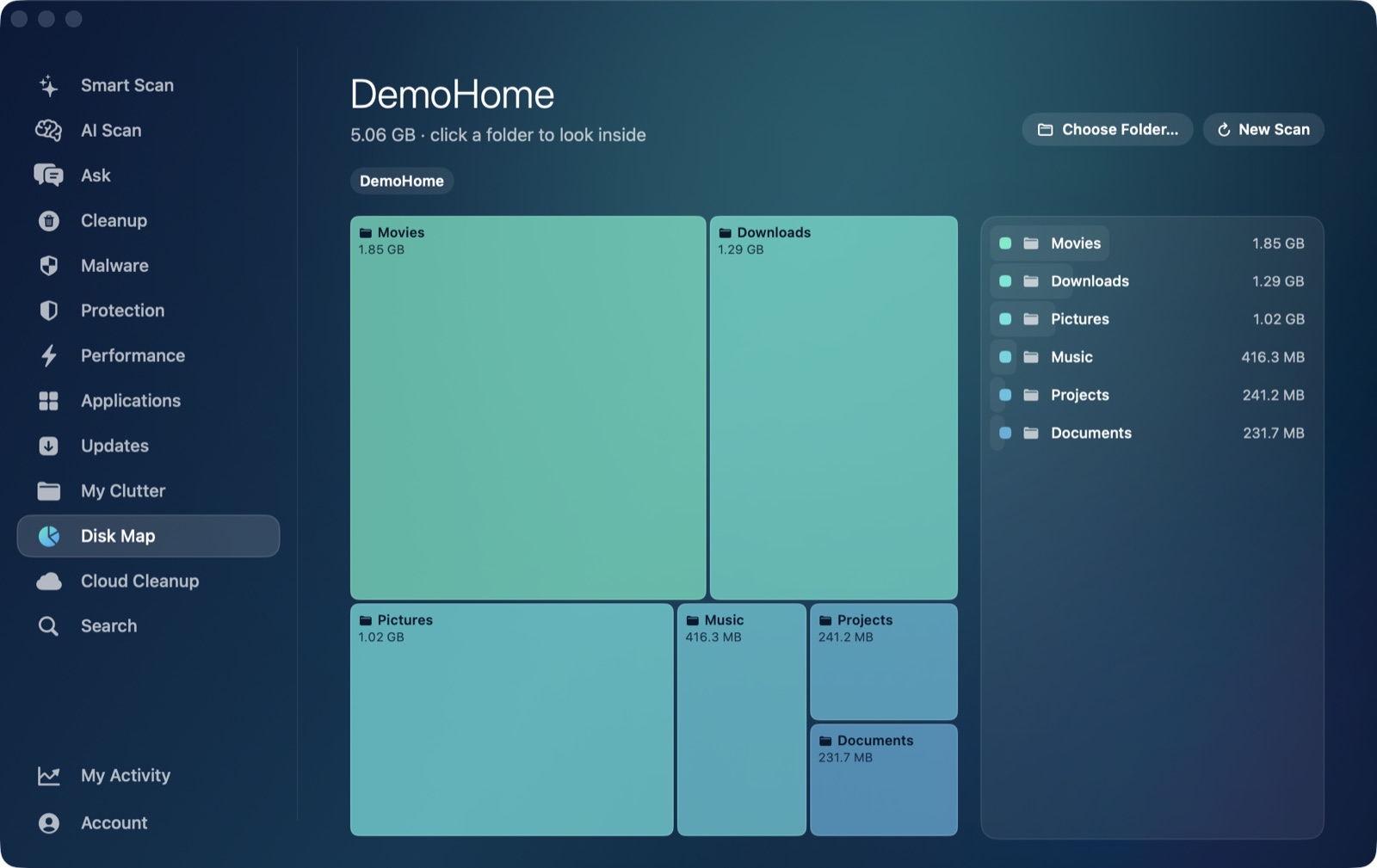
AI Mac Cleaner's Cloud Cleanup module detects OneDrive the same way it detects iCloud Drive, Google Drive, Dropbox and Box: by scanning ~/Library/CloudStorage for a folder whose name starts with OneDrive. It lists every account it finds — including multiple OneDrive accounts side by side — with the local footprint on this disk and the largest downloaded files inside each one, sorted biggest first, so you're working from real numbers rather than guessing from Finder.
Because OneDrive isn't iCloud, the app is upfront about what it can and can't do here: iCloud Drive gets a true "Remove Downloads" action that hands a local copy back to the cloud without deleting anything (evictUbiquitousItem), but OneDrive and the other third-party providers don't expose that kind of API to any Mac app. For OneDrive, Cloud Cleanup's options are Show in Finder or Move to Trash, and it warns before you confirm that moving a OneDrive-synced file to the Trash deletes it from your Microsoft account too, not only from this disk — a meaningfully different action from clearing a cache, which is why the warning exists rather than treating every provider identically.
One deliberate gap: the scanner skips any folder that looks like a code project — containing a .git directory, package.json, .xcodeproj, node_modules, or similar markers — entirely, so a repository you happen to sync through OneDrive is never surfaced as "large downloaded files" to clean. OneDrive's own cache sits outside ~/Library/CloudStorage in Application Support, so Cloud Cleanup doesn't scan or touch it either way — OneDrive's own Settings remain the right place to clear that. If you're removing OneDrive from this Mac entirely rather than just freeing space, see how to uninstall OneDrive completely on a Mac; for the same local-storage confusion with a different provider, see why Google Drive takes up space on a Mac.
AI Mac Cleaner has a 7-day free trial with every feature unlocked and no card required, plans from $6.99/mo after.
Frequently asked questions
Why is OneDrive using so much space on my Mac if Files On-Demand is supposed to keep it in the cloud?
Files On-Demand keeps files as cloud placeholders by default, but anything marked "Always keep on this device" — via Finder's right-click OneDrive submenu — forces a full local copy regardless of that setting. It's easy to set this once for offline access and forget it's still active.
Where does OneDrive store files locally on a Mac?
Under ~/Library/CloudStorage/OneDrive-<account>, the same general location Apple's cloud-storage framework uses for Google Drive, Dropbox and Box. A separate sync cache lives at ~/Library/Application Support/OneDrive.
I sync two OneDrive accounts — do they share the same Files On-Demand setting?
No. Each account gets its own folder under ~/Library/CloudStorage with independently managed Files On-Demand status, so a file kept locally in one account says nothing about the other.
Will moving a OneDrive file to the Trash on my Mac delete it from my Microsoft account?
Yes, for a file inside your synced OneDrive folder — unlike clearing a cache, this deletes the content from your account, not just from this Mac. AI Mac Cleaner's Cloud Cleanup module warns about this before you confirm.
Can AI Mac Cleaner free up space from OneDrive without deleting it from my account?
Not the way it can for iCloud Drive, which supports evicting a local copy back to the cloud with nothing deleted. OneDrive and the other third-party providers don't expose that option to any Mac app, so the fastest safe route is OneDrive's own "Free up space" command in Finder, or Cloud Cleanup's Show in Finder / Move to Trash for the rest.